
Phones and everyday life · about 3 minutes to read
Topics: Work and availability Rest and free time
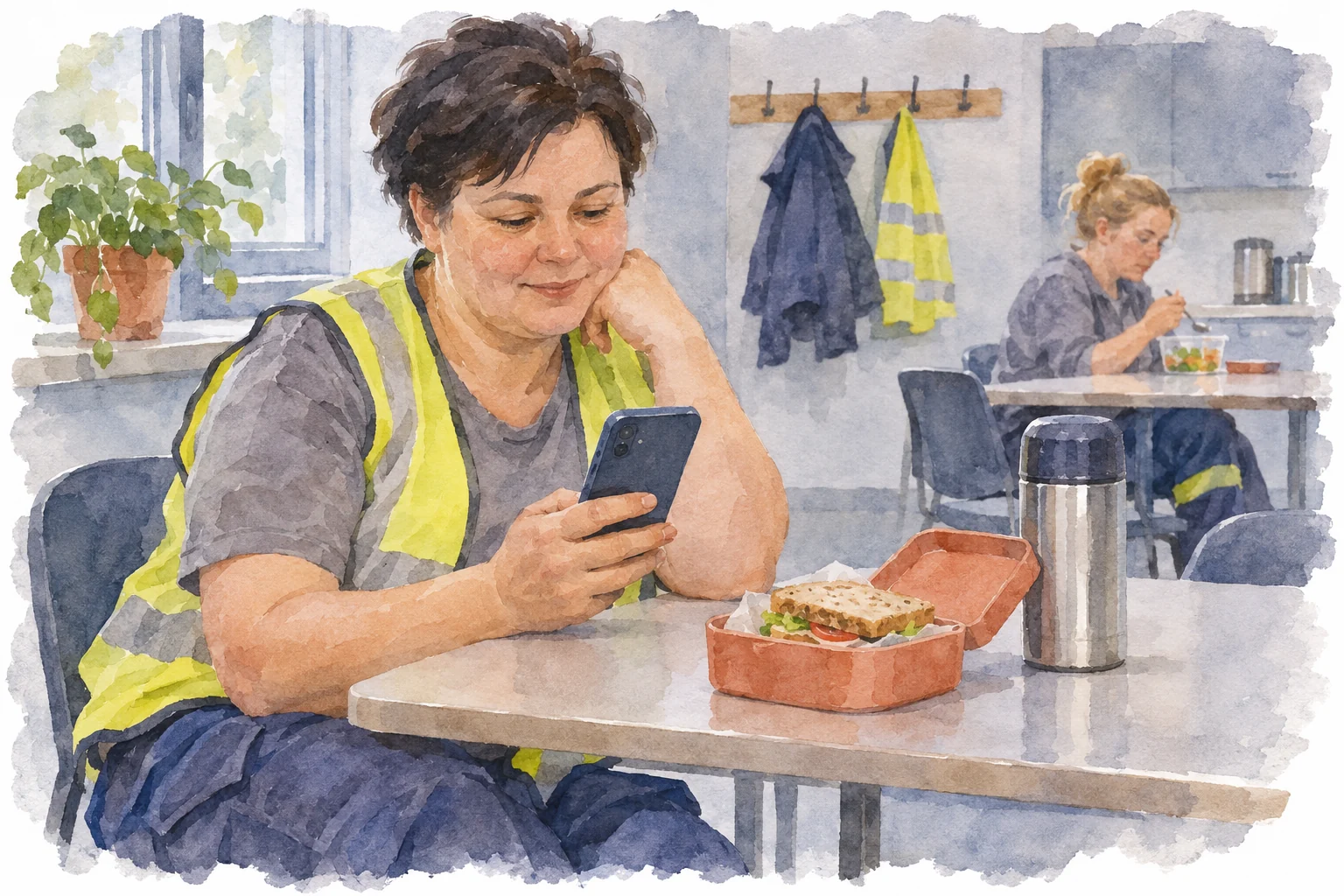
You sit down with your lunchbox. At last you can take off your gloves, have some tea and stop answering questions for a moment. Your phone is within reach. One video, then another. When it is time to go back, the sandwich is eaten, but it is hard to say whether you have had a rest.
This can happen in a warehouse, a shop, a workshop or an office. Your phone gives you quick access to something other than work. Sometimes that is exactly what you need. At other times, it takes up almost the entire break, although what you needed most was quiet, an unhurried meal or a conversation.
A break can meet different needs
After several hours dealing with customers, you may not feel like saying a word. After working alone, you may need to hear someone’s voice. After physical effort, simply sitting down may matter. There is no reason to organise all these breaks in exactly the same way.
Likewise, using your phone is not a single activity. Messaging someone close to you, checking a bus time and scrolling through videos serve different purposes. It is not worth judging them solely by the fact that they all happen on a small screen.
What the experiment tested
Kang and Kurtzberg studied 414 people solving anagrams. During the task, some participants took a break by choosing products for a hypothetical shopping list: on a phone, a computer or paper. Others worked without a break. After the phone version, performance on the remaining task was worse than after the other two types of break. [1]
This was not a test of watching videos during a warehouse shift. It examined a specific mental task and a particular way of using a device. The result should not become a slogan claiming that every minute with a phone prevents rest. It does, however, give us a reason not to assume that changing the screen or the content automatically offers a breather.
Did the tired part of you get a rest?
If the last few hours have involved constant choosing, checking and reacting, another batch of messages may not be what you feel like. And if you are feeling lonely, brief contact with someone close to you may matter more than quiet alone.
These are examples to recognise in your own day, not findings from a separate study. After a break, you can check whether you feel less tense, whether you managed to eat calmly and whether you are returning to your duties without feeling that the time disappeared before you knew it.
The point is not to turn rest into another task to complete. A break does not have to serve greater productivity. It is also your time for food, contact and simply doing nothing.
Without judging someone else’s break
The person beside you on their phone may be talking to their child or dealing with something urgent. You cannot tell from the outside. It is worth giving yourself the same respect: one break spent watching videos is not evidence of a problem.
But if it regularly ends differently from how you want, you can start by naming what is missing. “I want to eat in peace” says more than a general resolution of “I must use my phone less”.
A question to reflect on: What do you need most during this break, and is your phone giving you that right now?
The free Mapa Smartfonowych Nawyków (Smartphone Habit Map) lets you look at the way you use your phone. The result is for reflection, not a diagnosis.
Read also
One more video. Why does scrolling not always help with boredom?
Work is over. Why are you still checking your work phone?
Source
[1] Kang S., Kurtzberg T. R. (2019). Reach for your cell phone at your own risk: The cognitive costs of media choice for breaks. Journal of Behavioral Addictions, 8(3), 395–403. An experiment involving anagrams and a shopping task; not a study of warehouse workers’ breaks or scrolling through videos. Publication.
