
Phones and everyday life · about 3 minutes to read
Topics: Later life and independenceFamily and relationships
“Show me where it is.” You take your mum’s phone, tap a few times and hand it back with the job done. Sorted. A week later, the same question comes up.
Perhaps the help only solved today’s problem. Your mum had no chance to go through the steps herself. Or perhaps the app’s screen has simply changed, or the previous explanation was too quick. A repeated question alone tells us nothing certain about someone’s abilities.
Age is not an instruction manual for a person
One older person uses banking and video calls without help. Another is only getting used to a touchscreen. Someone knows their own phone well but gets lost after an update. It is worth getting to know these differences rather than assuming what “an older person can do”.
A simple question can be a starting point: what do you want to do? Send a photo, find a message, talk to a grandchild? A specific goal helps keep the conversation focused on what is actually needed now.
There is no need to show every useful feature in one visit. To someone asking for help, more options may simply mean more things to remember.
The phone can stay in its owner’s hands
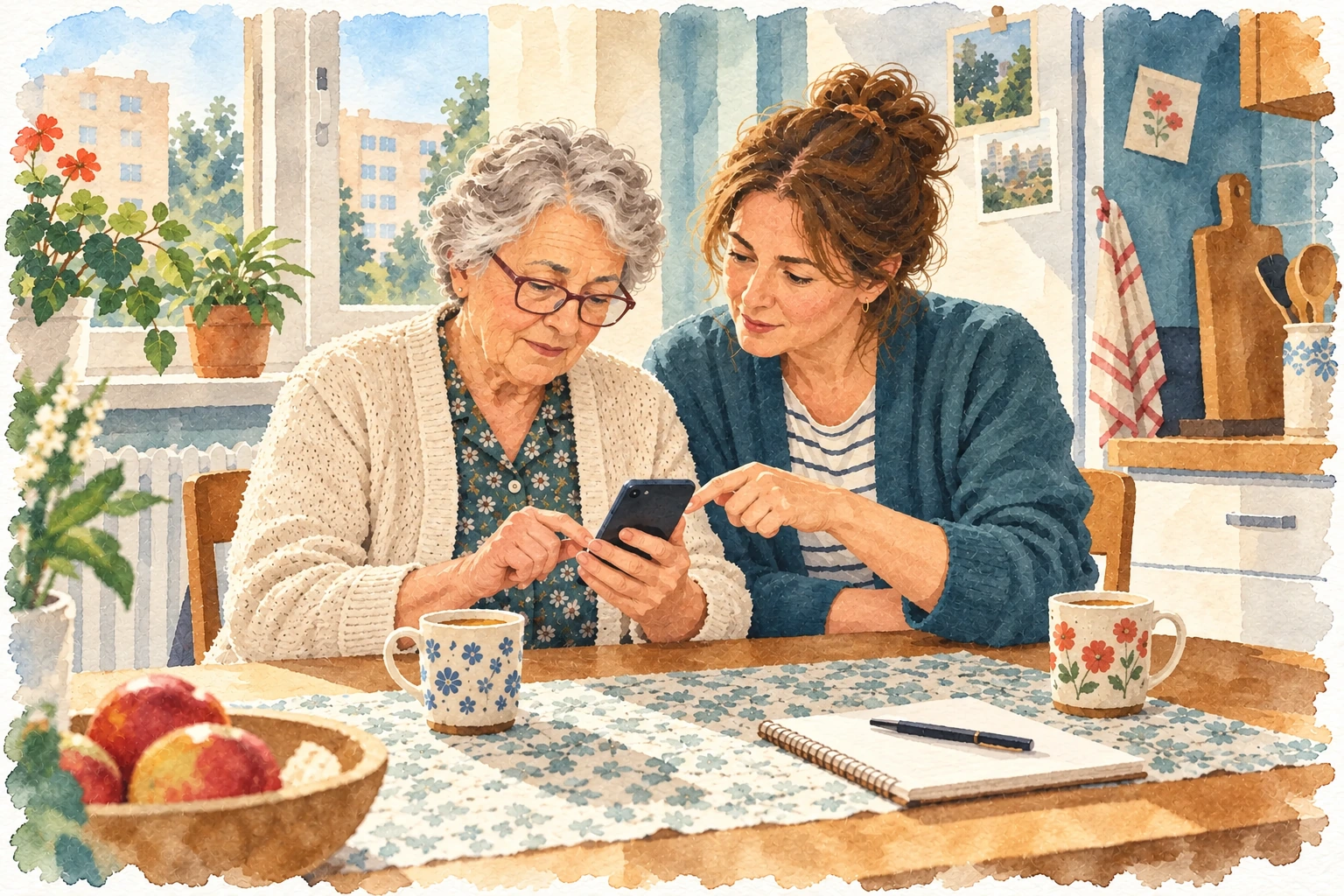
If someone close to you wants to learn a particular action, you can stay alongside them as they try. Wait for them to find the item on the screen. Ask what they see rather than giving several instructions at once. Leave time for a question.
This is a suggested way to talk, not a guaranteed teaching method. Sometimes a different form of support, larger text, help at a service point or another visit will be needed. Sometimes someone will simply ask you to deal with it for them today. What matters is that it is their choice.
Being independent does not mean having to do everything without help. You can know how to use a phone and still want to ask about an unclear message.
Safety without shaming
In its description of the guide “#Halo! Tu cyberbezpieczny Senior!”, NASK links education about risks with the ability to use the internet independently and stay in touch. The material includes examples of scams and guidance on protecting data. [1]
You can look at materials like these together rather than building the conversation entirely around what someone did wrong. Feeling able to ask before making a decision matters even when someone has used the internet for years.
Helping does not require you to know a password or take over access to an account. Explaining an everyday action can be kept separate from access to private messages and confidential data.
Using it more, or using it your own way?
The goal need not be to move your whole life onto a phone. For one person, a video call with family will matter. For another, checking the bus timetable independently before going out. Technology can make things easier and then let people return to their own activities.
The person helping can also notice their own hurry. Do I want to finish the task quickly, or give someone close to me the chance to do it next time? Both needs can be understandable. It helps to tell them apart.
A question to reflect on: after you last helped someone close to you with their phone, did they know more, or was the job simply done?
The free Mapa Smartfonowych Nawyków (Smartphone Habit Map) looks at your own situations with your phone. It is not a digital skills exam or a tool for judging someone close to you.
Read also: Less phone time does not have to mean a new hobby.
Further reading
[1] NASK (2024), “Poradnik «#Halo! Tu cyberbezpieczny Senior!». Podaruj bliskim wiedzę i spokój”. Educational material about using the internet safely. Description and link to the guide.
