
Phones and everyday life · about 3 minutes to read
Topics: Children and schoolFamily and relationships
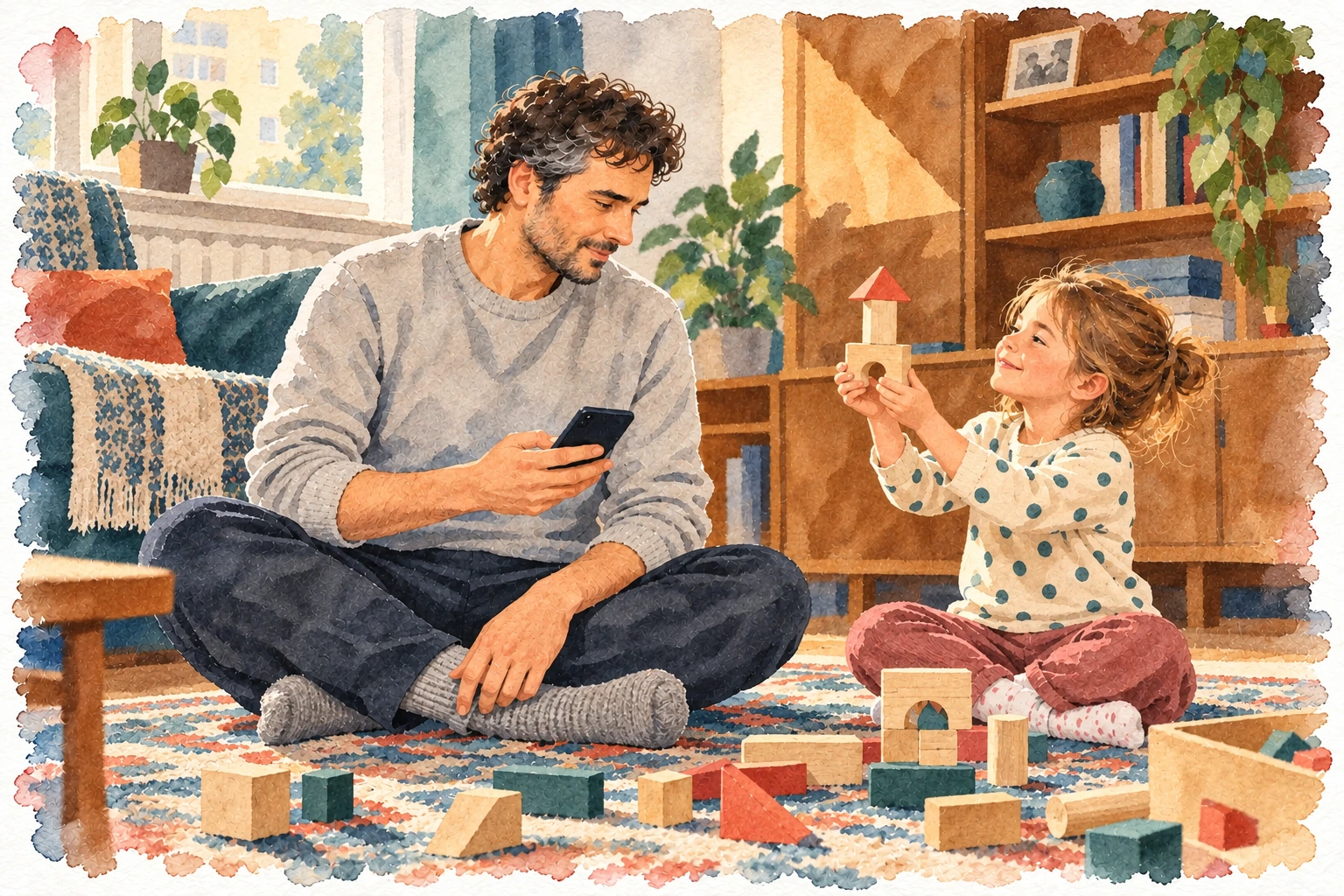
You are sitting on the carpet. Your child finishes a tower of blocks and calls, “Dad, look.” At that very moment, a message arrives. You glance at it and reply with two words. When you look up, the tower has fallen and the game has moved elsewhere.
This is an imagined scene, but it is easy to relate it to your own day. It need not become a test of good parenting. You can treat it as a question about what sometimes slips away between one glance and the next.
A phone helps organise family life
A message may concern a school pick-up, a doctor’s appointment or a change in schedule. Having a smartphone out near your child does not automatically mean ignoring them. Often it is exactly how you organise everyday life together.
What happens next can matter more than the device simply being there. Do you deal with a specific matter and return to playing? Or does one reply lead to another check, even though the original matter is already settled?
A child cannot see the difference between an urgent message and browsing updates. A brief explanation of the interruption may make more sense than another “just a moment”. You do not have to tell them about every adult concern.
What are researchers actually studying?
In a paper published in “Child Development”, Brandon McDaniel and Jenny Radesky described links between parents’ use of technology, interruptions to shared activities and child behaviour difficulties reported by parents. This was a study based on self-reports, not an experiment that could establish the phone as the cause of those difficulties. [1]
It does not show that replying to a single message harms a child, or that a phone explains a particular family’s behaviour. The study draws attention to repeated interruptions. That is a much narrower question than judging all of parenting by minutes on a screen.
You do not have to be available all the time
Parents are entitled to work, rest and their own conversations. Not every moment with a child requires complete attention on them alone. Still, it is worth recognising the moments that matter to you: building together, the journey home from school, a bedtime story.
Recall one such situation. What was supposed to happen? What interrupted the contact? After putting the phone down, did you return to the activity together, or had you both moved on to something else?
The answers need not lead to a household ban. They can help you notice the difference between a necessary break and a reflex that quietly made your absence longer.
Coming back is part of time together too
If you missed the tower, you can take an interest in what your child is doing now. Without a grand promise that you will never look at a screen again. A simple “will you show me again?” can be more honest than a plan for perfect presence all day.
You can also notice whether playing together becomes another opportunity to take photos, choose the best shot and send it to the family. A memory is lovely. The moment itself can also be enough.
A question to reflect on: what was the last moment with your child that you really wanted to notice before it ended?
The free Mapa Smartfonowych Nawyków (Smartphone Habit Map) lets you look at your own situations with your phone. It is not for assessing a child or their development.
Also read: We are together, but our attention is elsewhere. A phone between people.
Source
[1] McDaniel B.T., Radesky J.S. (2018), “Technoference: Parent Distraction With Technology and Associations With Child Behavior Problems”, Child Development, 89(1), 100–109. A self-report study of associations; it does not establish causes within an individual family. Publication abstract.
