
Phones and everyday life · about 3 minutes to read
Topics: Attention and everyday habitsLater life and independence
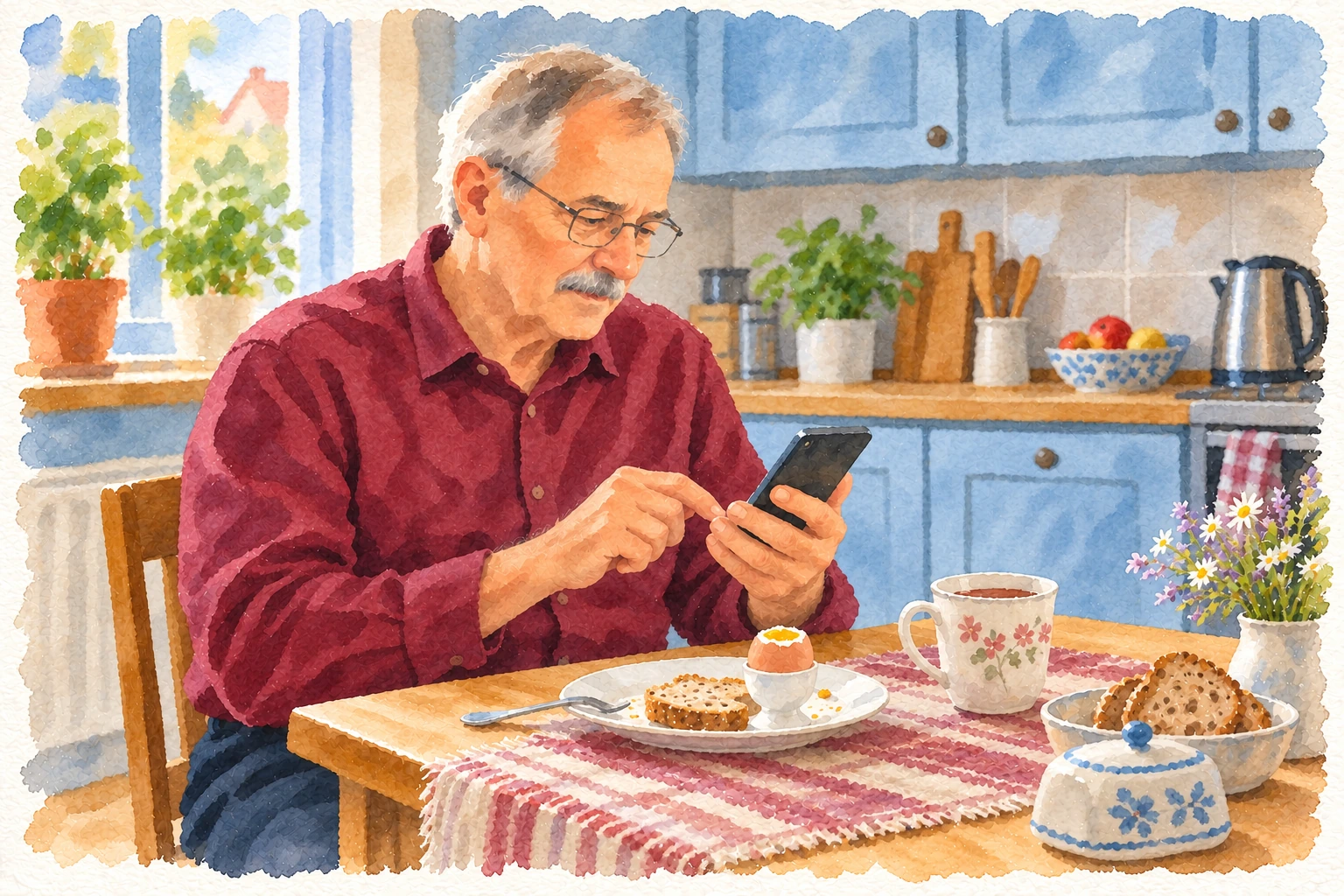
Tea is on the table; breakfast is ready. You want to check what has happened since yesterday. You read an article, then comments and another report. A moment later, you return to the homepage to check whether something new has appeared.
An interest in the news is understandable. Information helps us make decisions and understand the world. The difficulty begins when it is hard to stop checking, even though you are no longer getting an answer to any new question.
Being informed does not require knowing everything
Some information affects a specific action: a weather warning, a timetable change, the situation where loved ones are staying. Then there are more opinions, replayed recordings and predictions. They may be interesting, but they do not serve the same purpose.
In one stream, they are easy to mix up. An urgent announcement sits beside a comment that merely sounds urgent. Before you finish one matter, the next headline offers another. This does not mean that all news is false. It means that the availability of new content offers no natural signal to stop.
What does research show?
Bryan McLaughlin and colleagues studied the relationship between news consumption that is hard to control and disrupts everyday life, and wellbeing among adults in the USA. People reporting more such difficulties also reported poorer mental and physical wellbeing. [1]
This was a survey. It does not settle which was the cause and which the effect. Poorer wellbeing may encourage more frequent checking, and other circumstances may also matter. The finding does not justify treating every reader interested in the news as someone with a problem.
A narrower point matters: it is worth looking not only at how many articles you read but also at whether you can stop reading and return to your day.
Are you checking a fact or waiting for reassurance?
Sometimes we return for a specific piece of information. At other times, we hope the next refresh will provide certainty that everything will be all right. A news service can rarely offer that certainty. It can, however, provide another comment on the same uncertainty.
Try to recall the last few times you returned to the news. Did you learn something that changed your understanding of the situation? Or did you mainly confirm what you already knew? These are questions about your own experience, not a diagnostic test.
A break does not mean indifference
You can care about events and still eat breakfast, go for a walk or get on with work. Ending your reading is not a declaration that you no longer care about other people’s lives.
The quality of information matters too. The publication date, the original source and a distinction between fact and opinion can tell you more than the number of successive posts. An old recording shared today does not automatically become a report of today’s events.
There is no single right amount of news for everyone. There is, however, a difference between reading that leaves you understanding more and returning that leaves you in the same place, finding it increasingly hard to do something else.
A question to reflect on: Did your last refresh bring new information or just another version of the same worry?
The free Mapa Smartfonowych Nawyków (Smartphone Habit Map) helps you look at your own phone use. It does not assess your views or how interested you are in the world.
Read also: You are not out of bed yet, but you are already checking. Starting the day with your phone.
Read also: You are not replying, but you are still waiting. How a phone takes up attention.
Sources
[1] McLaughlin B., Gotlieb M.R., Mills D.J. (2023; published online 2022), “Caught in a Dangerous World”, Health Communication, 38(12), 2687–2697. A survey on news consumption and wellbeing; an association does not establish causality. Go to source.
