
Phones and everyday life · about 3 minutes to read
Topics: Children and school Family and relationships Attention and everyday habits
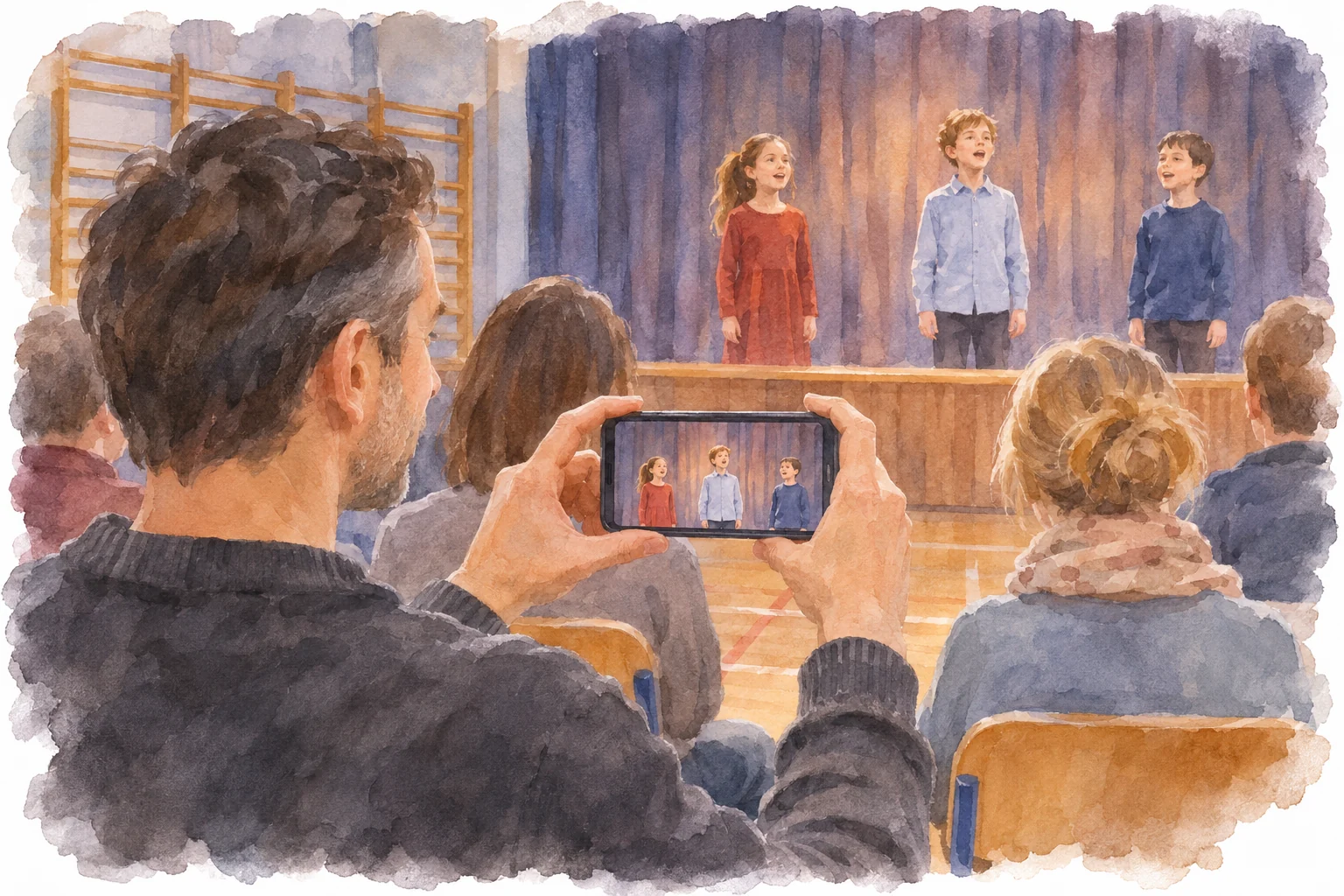
The children come onto the school stage. Someone adjusts a microphone; someone looks for their parents. You take out your phone to keep this moment. A minute later, you are mainly checking whether everyone fits in the frame and whether your hand is shaking too much.
A recording can be a treasured keepsake. It can also let someone close to you see a performance they could not attend. There is no reason to treat switching on the camera itself as a lack of interest in your child. It is simply worth noticing when recording an event starts to take more attention than the event itself.
Photos can help you experience the moment
The familiar advice “put the camera away or you will not experience anything” is too simple. In a series of nine experiments, Diehl, Zauberman and Barasch showed that taking photographs can increase enjoyment of positive experiences when it helps people engage with them. The benefit did not appear in every setting, however, including when photography interfered with the experience. [1]
You may therefore look more closely precisely because you are seeking a composition. You may also be so busy operating the device that following what is happening around you becomes difficult. Simply having photographs does not settle the question.
Remembering images and remembering sounds
In another study, Barasch and colleagues examined what participants remembered after experiences during which they could freely take photographs. Compared with people without that opportunity, they recognised visual elements better and auditory information less well. The authors link this to a shift of attention towards what can be seen. [2]
The study concerned taking photographs, not recording school performances. It does not prove that filming will make you forget your child’s words. It does, however, suggest distinguishing different parts of an experience: images, sounds and your own presence there.
What becomes the main activity?
At a concert, you can briefly record a favourite part. You can also spend the whole song adjusting the focus and avoiding the head of the person in front. At a school performance, there is also the wish to capture your child’s entrance, smile and final bow.
At such a moment, it is easy to have two parallel tasks: watching and documenting. You do not have to give up either in advance. You can notice which matters more to you at that moment and whether your current way of recording allows for it.
It also helps to separate keeping a memory from publishing it. A recording for a grandmother does not have to become a story shared with all your friends straight away. These are two different decisions, particularly when other children appear in the frame.
Your gallery does not need a complete record of every moment
A few photographs, a short film, a full recording or none of these: different choices can make sense. You do not have to prove your interest through the length of a video or by giving up your phone.
If, after the event, you mainly remember keeping an eye on the screen, that is useful information about this particular experience. Next time, you may want to divide your attention differently. Without accounting for every minute you did or did not record.
A question to reflect on: What do you want to keep from this moment: a recording, your own experience, or a little of both?
The free Mapa Smartfonowych Nawyków (Smartphone Habit Map) lets you look at the way you use your phone. The result is for reflection, not a diagnosis.
Read also
The photo stays on your phone. Not every moment needs to be posted
Children see more than our rules. What they learn by watching us with our phones
Sources
[1] Diehl K., Zauberman G., Barasch A. (2016). How Taking Photos Increases Enjoyment of Experiences. Journal of Personality and Social Psychology, 111(2), 119–140. A series of experiments on taking photographs and enjoyment of experiences. Publication.
[2] Barasch A., Diehl K., Silverman J., Zauberman G. (2017). Photographic Memory: The Effects of Volitional Photo Taking on Memory for Visual and Auditory Aspects of an Experience. Psychological Science, 28(8), 1056–1066. Studies of memory after freely taking photographs; not a test of recording performances. Publication.
