
Phones and everyday life · about 3 minutes to read
Topics: Children and schoolFamily and relationships
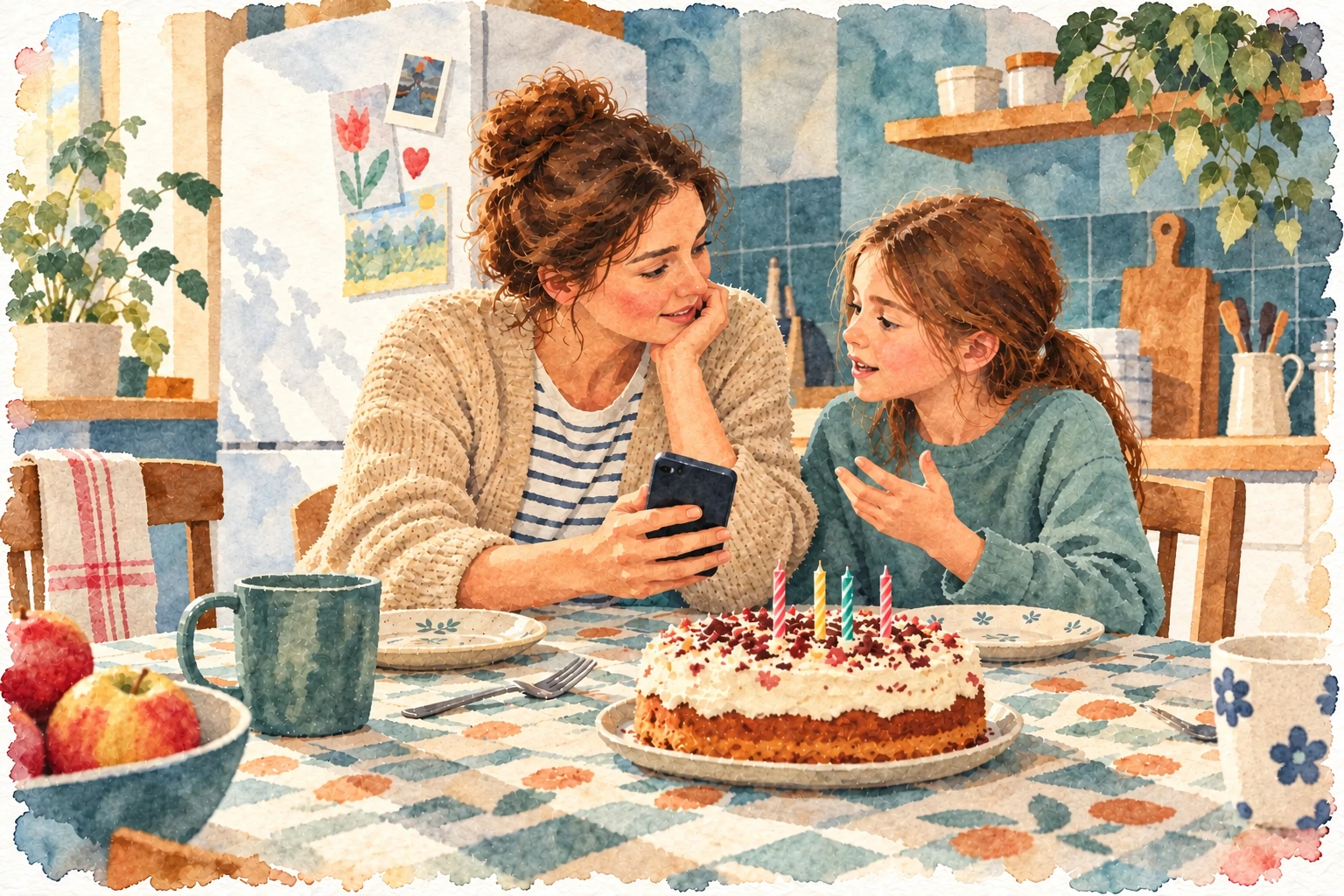
The cake is still on the table. Your child has blown out the candles and someone has taken a photo. You open it and instinctively look for the share button. Surely family and friends will be delighted.
Yet taking a photo and posting it are two separate decisions. You can keep a memory without turning it into a post. You can also ask whether the person in the photo wants others to see it at all. That includes children.
Good intentions do not answer every question
Photos help us share joy and stay in touch with loved ones who live far away. Taking a photograph does not in itself mean that the moment together stops mattering.
Still, it is worth separating a few things: taking a photo, showing it to one person, sending it to a group and making a public post. They differ in who sees them and how easily the material can travel further. A message in a closed group can also be copied or forwarded.
In their guide to children’s images, UODO and the Orange Foundation encourage adults to reflect before sharing and to consider a child’s welfare and opinion. They point out that published material may be shared further and used in other contexts. [1]
“Can I show this photo?”
This question gives a child a chance to express their own view. It helps if “no” can genuinely change something. Otherwise, the conversation simply announces a decision that has already been made.
This is not about handing all the responsibility to the child. A young child does not have to understand who will see a post or how long the photo will remain available. The adult still judges whether posting it is necessary and appropriate.
Very personal or embarrassing moments do not become suitable for sharing just because adults find them funny. It is worth looking at the photo from the perspective of the person it shows.
A memory does not need an audience
A photo kept in the family album is no less valuable because nobody has liked it. You can return to it a month later, tell the birthday story and hear what your child remembers.
Sometimes this also changes how a gathering unfolds. Less time goes on choosing a shot, editing a caption and checking reactions. More remains for what is happening at the table. It need not become a new rule for every occasion. It can simply be an available choice.
It helps to include grandparents and other loved ones in a conversation like this too. Not everyone has the same posting habits. Agreeing on expectations can be easier before a family gathering than after a photo has been shared.
What prompts you to press share?
Wanting to share joy? Wanting to keep a memory? Waiting for reactions? Each answer describes a slightly different need. You do not have to judge it to notice whether a public post is really the best response.
A question to reflect on: did you mainly want to remember the last lovely moment, or show it to others?
If you want a broader look at your own phone habits, you can start with the free Mapa Smartfonowych Nawyków (Smartphone Habit Map).
Read also: “Dad, look.” When a phone interrupts time with your child.
Further reading
[1] Personal Data Protection Office and Orange Foundation (2024), “Wizerunek dziecka w internecie. Publikować czy nie?”. A guide we refer you to for a fuller discussion of protecting images and privacy. Publication page.
