
Phones and everyday life · about 3 minutes to read
Topics: Children and schoolFamily and relationships
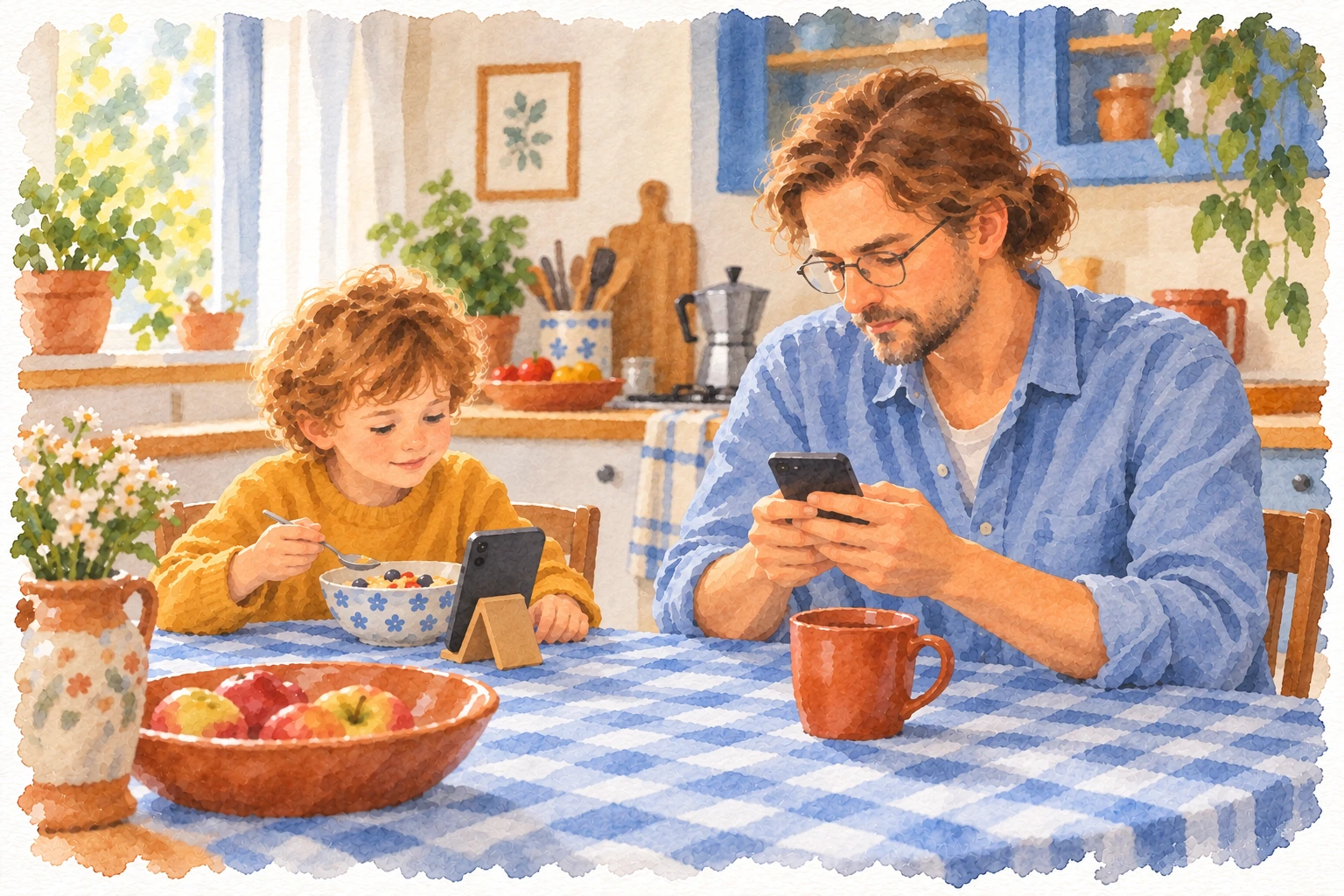
At the table, a child watches something on a phone placed on a stand. The adult sitting nearby also glances at their own screen. Later comes the request: “Put your phone down while you eat.” The child may ask: “What about you?”.
This is not evidence of parental failure. It is a situation in which a rule meets everyday behaviour. Children hear our explanations, but they also see why and how often we reach for a device ourselves.
A child sees the screen, but not always its purpose
On the same phone, you can pay a bill, answer an urgent message, watch a video or check a match result. From the outside, some of these activities look similar. A younger child in particular may not understand why one interruption matters and another can wait.
A brief explanation can make the situation clearer: “I am checking the appointment time, then putting it down.” What happens afterwards matters too. If you move on to the news after checking the date, the child sees a different sequence of behaviour from the one you announced.
What can research tell us?
A systematic review and meta-analysis published in “JAMA Pediatrics” in 2025 found small associations between parents’ technology use in the presence of young children and some outcomes concerning children’s development, behaviour and screen time. [1]
Such associations do not prove that a child uses a screen solely because they are copying a parent. Shared living conditions, stress and other factors may matter. Nor can this work predict the effect of checking a single message.
The research gives us a reason to include adults’ behaviour in conversations about family screens. It does not justify blaming a parent for every difficulty a child experiences.
A shared rule does not mean identical permissions
Adults and children have different responsibilities and needs. They do not have to use the same content or follow identical rules. Still, it is worth being able to explain the difference with more than “because I am an adult”.
If the conversation is about attention during a meal, the question includes the adult too. If it concerns work contact, you can explain that need and its limits. A rule becomes easier to understand when its purpose and its exceptions are clear.
The slogan “phones are bad” is hard to reconcile with everyday life in which we use them to talk to family, find information and get things done. A child needs a more concrete picture of technology use.
We also show how to finish
A model can be more than a phone put away; it can also be the end of a completed task: “I have sent it now. I am listening.” Or noticing your own interruption: “I started checking something else and missed what you were saying.”
This does not require pretending to be a perfect phone user or telling your child about every private message. It lets you show that using a phone has a purpose, an ending and an effect on people nearby.
Before the next conversation begins with counting your child’s minutes, it is worth looking at one shared situation. What rule can be seen in practice, including on our side of the table?
A question to reflect on: What way of using a phone do our everyday actions teach, regardless of the rules we state?
The free Mapa Smartfonowych Nawyków (Smartphone Habit Map) can help you look at your own behaviour. It is not a tool for assessing a child’s development or diagnosing a child.
Read also: “Dad, look.” When a phone interrupts time with your child.
Read also: Your child is asleep. Do you now have to catch up with the whole internet?.
Sources
[1] Toledo-Vargas M. et al. (2025), “Parental Technology Use in a Child’s Presence and Health and Development in the Early Years”, JAMA Pediatrics, 179(7), 730–737. Systematic review and meta-analysis; small associations do not establish the cause in a particular family. Go to source.
