
Phones and everyday life · about 3 minutes to read
Topics: Rest and free timeFamily and relationships
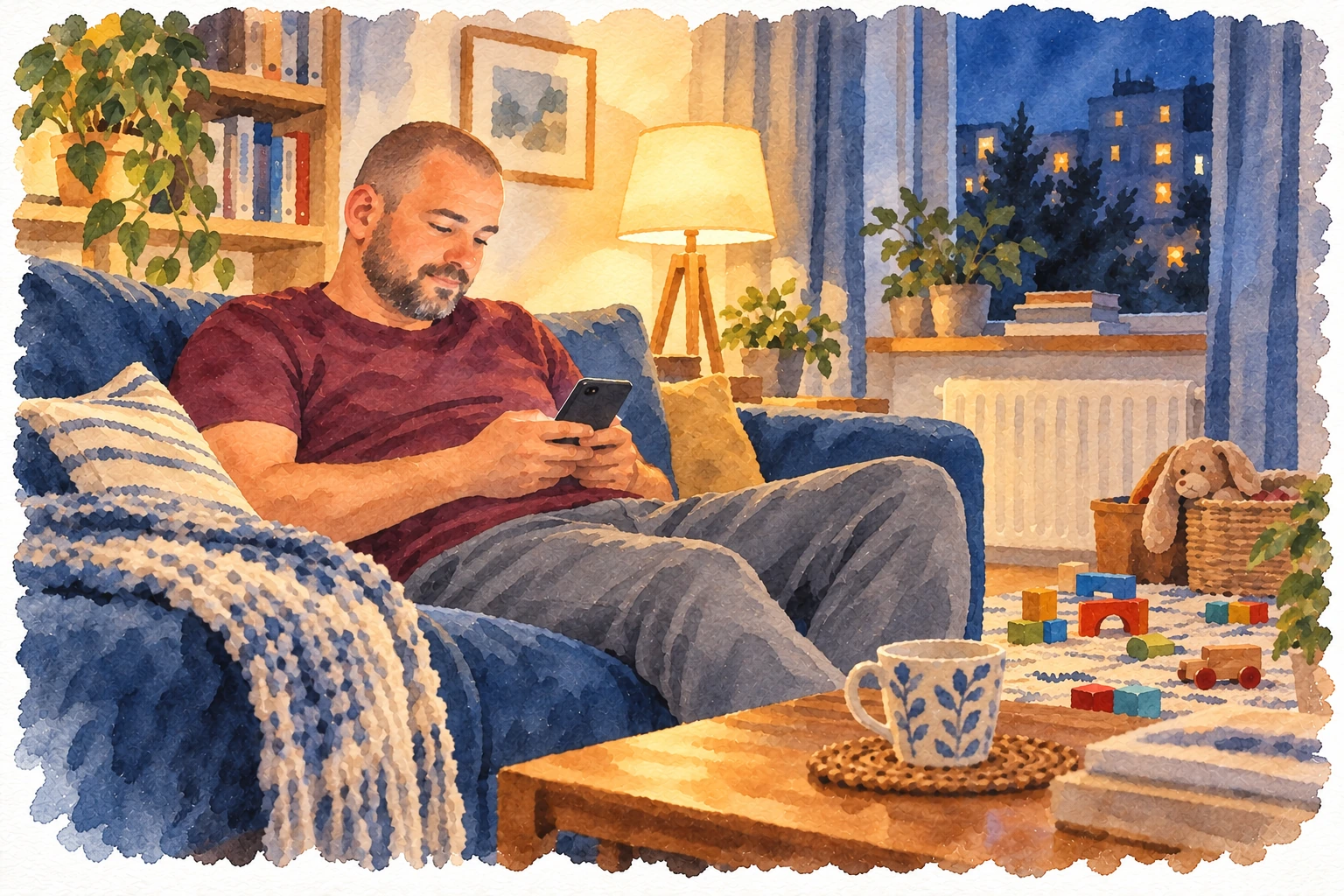
At last, the flat is quieter. Your child is asleep, and a few toys remain on the floor. You sit on the sofa and pick up your phone. You can read something to the end, reply to friends or simply look at something that nobody needs from you.
That is an understandable need. After a day of caring, you do not have to earn your rest as well. Your phone is within reach and needs no preparation. Still, sometimes it is worth checking whether this moment gives you what you hoped for.
Not everything you do on the sofa is time for yourself
Your phone holds entertainment, conversations, shopping and family organisation. You can start with a funny video and end up ordering shoes, replying to nursery messages and comparing appointment dates.
From the outside, all this time looks similar: you sit and look at a screen. For you, however, it may be a mixture of rest and another shift of household work. The number of minutes alone will not show how many truly belonged to you.
Pleasure needs no justification
You can watch something light simply because it is enjoyable. Not every evening has to involve personal development, reading or a hobby. After a difficult day, an ambitious plan for relaxation can become another task left undone.
In a survey by Leonard Reinecke and colleagues, guilt related to viewing media entertainment as putting off duties was associated with a weaker experience of recovery. [1] The study did not specifically examine parents of young children or today’s scrolling through short videos.
It therefore cannot provide a recipe for a parent’s evening. It does show, however, that the way you judge your own rest deserves attention too. Blaming yourself alone does not explain what you need.
“Just a little longer” can mean different things
Sometimes it really is a few enjoyable minutes. At other times, stopping is hard because putting down the phone means the end of the only part of the day without duties. You can also simply lose track of time. These are different possible experiences, not one diagnosis.
Think of a particular evening. Did you want contact with adults, entertainment, quiet or perhaps a moment when you could make your own decisions? Did your phone give you that? Afterwards, was it easier to rest, or did you feel that your own time had disappeared again?
A parent needs room in their day too
If evenings keep running late, it is worth seeing their context too: how care is shared, work, lack of support and lack of sleep. Not everything can fairly be reduced to willpower in the face of an app.
Perhaps a conversation about when you have time during the day without being on caring duty will matter more than another promise to put your phone down. That is not always easy to arrange. Naming the need will not solve every difficulty, but it helps you understand why you reach for a screen in the evening.
You can have a right to this moment and also notice that it does not always end as you wanted. The two can coexist.
A question to reflect on: What did you need after putting your child to sleep, and did your last evening with your phone actually give you that?
The free Mapa Smartfonowych Nawyków (Smartphone Habit Map) lets you look at your own situations with your phone. Without judging you as a parent.
Read also: It was meant to be rest. Why does an evening with your smartphone run on?.
Read also: “Dad, look.” When a phone interrupts time with your child.
Sources
[1] Reinecke L., Hartmann T., Eden A. (2014), “The Guilty Couch Potato”, Journal of Communication, 64(4), 569–589. A survey on evaluations of media entertainment and the experience of recovery; not a study of parents’ evenings. Go to source.
