
Phones and everyday life · about 3 minutes to read
Topics: SafetyAttention and everyday habits
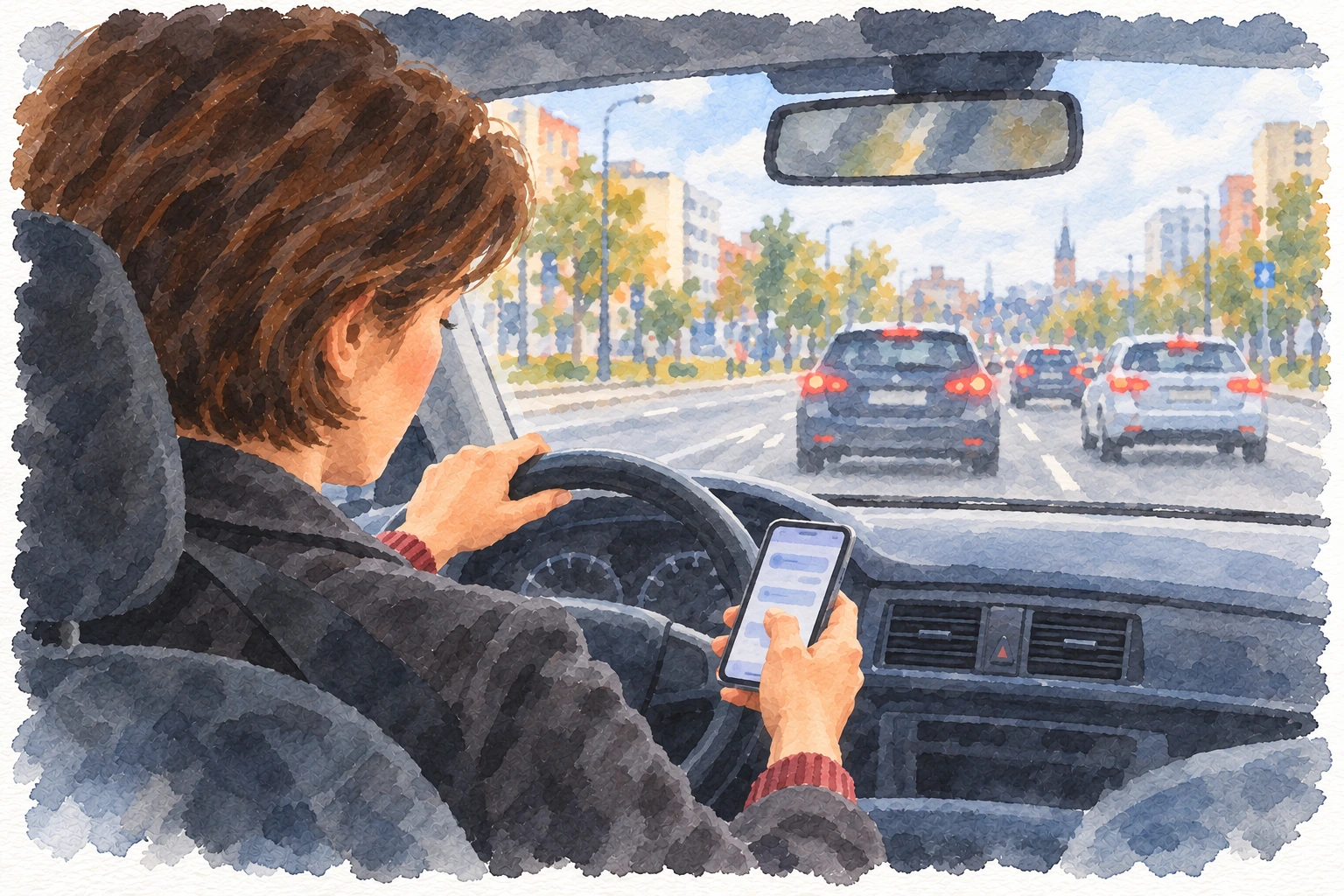
Your phone signals a message. You are driving a familiar route, and the cars ahead are moving steadily. You only want to see who has written. Replying will take a moment. At the same time, someone in front of you starts braking.
This situation differs from an extended scroll on the sofa. When driving, your safety and other people’s safety depend on how you divide your attention. Here, simply saying that everyone uses their phone in their own way is not enough.
A phone occupies more than one hand
Reading a message takes your eyes off the road. Typing occupies a hand. Understanding the content and composing a reply take attention that is needed to assess what is happening around the car. These types of distraction can occur together.
WHO points out that using a phone while driving slows reactions and makes it harder to maintain lane position and a proper following distance, among other things. In its road safety fact sheet, the organisation reports about four times the crash risk for drivers using a phone compared with those who are not. [1]
This is a general estimate, not an exact calculation for every glance, driver and type of app. Nor does it mean that every phone activity carries the same risk. The conclusion remains clear: using a device while driving can make safe driving significantly harder.
“It is only two seconds”
At 50 km/h, a car travels about 28 metres in two seconds. This is a simple distance calculation, not a finding from a study of reaction times. It does, however, show why a brief moment looking at a screen is not a moment in which your surroundings stop changing.
You do not have to be driving fast or on an unfamiliar route to need attention. A familiar street can still involve sudden braking, a change of traffic lights or a pedestrian appearing. Confidence is no substitute for watching the road.
A mount does not remove all distraction
A phone can help with navigation. Listening to directions set up beforehand is different from entering an address, looking for parking or reading about a place while driving. A mounted device can still draw your eyes and attention away.
Likewise, making a call without holding the phone does not automatically mean it has no effect on your driving. WHO also highlights cognitive distraction during hands-free calls. [2] Wolne ręce nie oznaczają pełnej uwagi na drodze.
An important matter can wait until you stop safely
Prepare your route and the settings you need before setting off. If you must operate the device, first stop safely somewhere you are allowed to park. Do not treat a brief stop in traffic as an opportunity to reply.
A passenger can help operate the navigation. Before you leave, you can tell someone waiting for a reply that you will get back to them after arriving. This is also about mutual expectations: do not pressure someone to reply when you know they are driving.
It is worth noticing the habit of reaching for your phone. In a car, however, the first step is to ensure safety; reflection on what made you check can wait until after the journey.
A question to reflect on: Do the people messaging you know that you do not expect yourself to reply immediately while driving?
After your journey, you can look at your automatic responses in the free Mapa Smartfonowych Nawyków (Smartphone Habit Map). Complete it only when you are not driving and can safely give it your attention.
Read also: Why are you checking your phone again? A reflex that is easy to miss.
Read also: Work is over. Why are you still checking your work phone?.
Sources
[1] WHO, “Road traffic injuries”, updated 20 July 2026, section on driver distraction. A general risk estimate is not a prediction for an individual person. Go to source.
[2] WHO (2011), “Mobile phone use: a growing problem of driver distraction”. The report explains cognitive distraction during calls, among other topics. Go to source.
